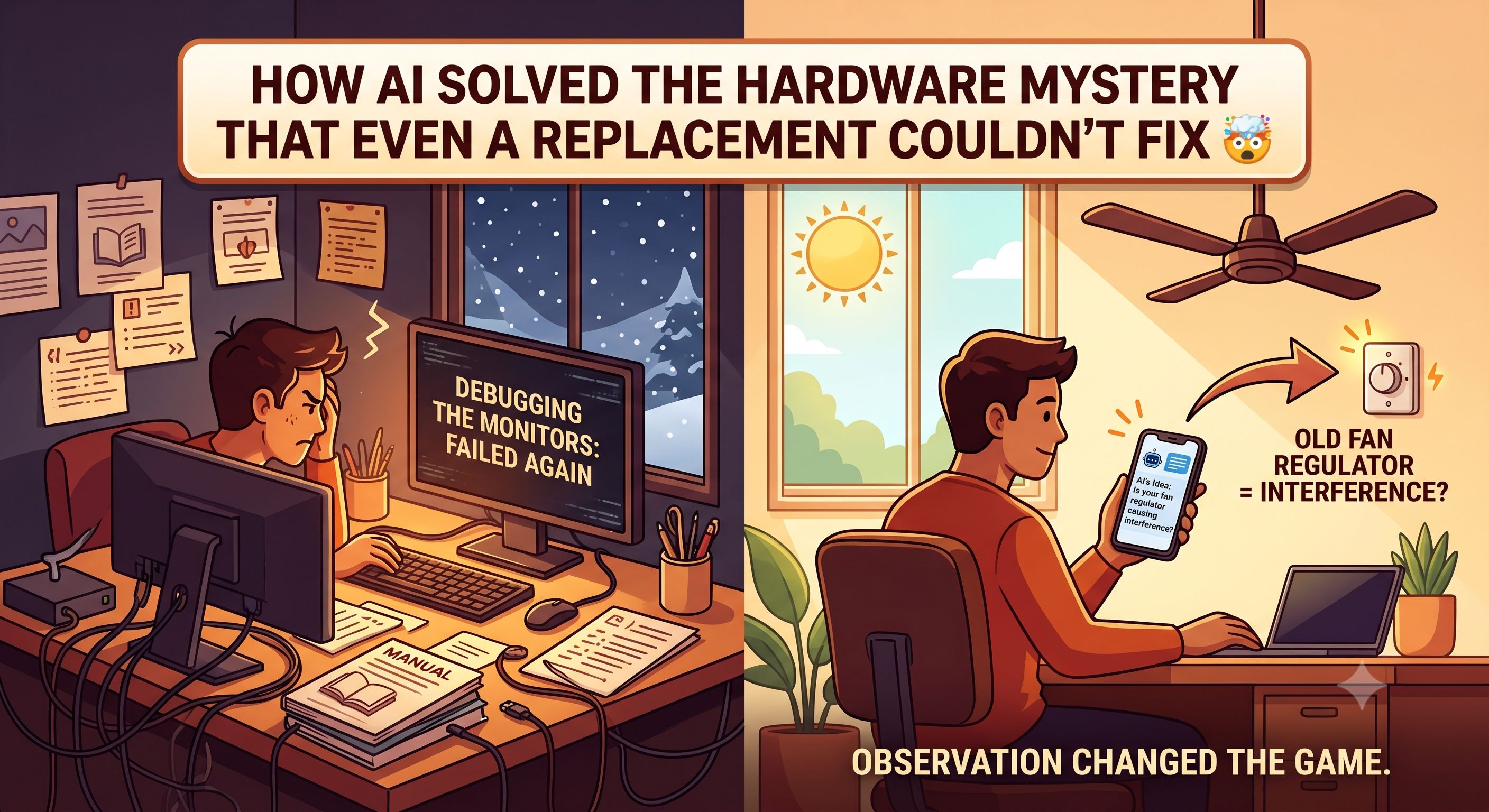
One of my friends bought a new monitor a few months ago.
Everything worked perfectly in the beginning, but as soon as the summers started, the monitor began flickering randomly.
Not every few minutes, not after heavy usage, just… randomly.
Like every engineer, the first instinct was, “This has to be a software problem.”
So the debugging started.
The usual debugging steps#
Before assuming anything fancy, we tried almost everything that normally causes display related issues.
- Different HDMI and DisplayPort cables.
- Different operating systems.
- Different laptops.
- Updated GPU drivers.
- Updated the monitor firmware.
- Factory reset of the monitor.
Nothing worked.
At this point, it looked like the monitor itself was faulty.
So we contacted customer support.
After explaining all the troubleshooting steps, the company agreed to replace the monitor with a completely new unit.
Problem solved?
Not really.
The brand new monitor started showing the exact same flickering.
Now things became interesting.
If two different monitors show exactly the same behaviour, then the monitor probably isn’t the problem.
So what is?
Hours of searching forums#
The next few days were spent doing what every developer eventually does.
Searching StackOverflow.
Searching Reddit.
Searching random forums from 2014.
Watching YouTube videos.
Trying fixes that made absolutely no sense.
Still nothing.
By this point we had ruled out almost every obvious possibility.
One night, instead of searching another forum, he decided to ask Claude.
But instead of asking,
“Why is my monitor flickering?”
he described everything.
Every troubleshooting step.
Every replacement.
Every failed attempt.
Every observation.
Including one detail that almost everyone ignored.
The monitor only started having issues in the summers.
The question that changed the whole debugging direction#
After reading everything, Claude didn’t immediately suggest another driver update or firmware patch.
Instead it asked a simple question.
Does anything else change in your setup during summers?
At first this sounded unrelated.
Then it asked another question.
What does the electrical switchboard where your monitor is plugged into look like?
The answer was something like this.
- Monitor power plug
- Fan switch
- Fan regulator
- A few other switches
And then Claude pointed out something that nobody had considered.
During winters, the fan regulator is almost never used.
During summers, it is.
It suggested that the older smooth rotary fan regulator could be introducing electrical noise or electromagnetic interference, affecting the monitor connected right beside it.
Honestly, this sounded too random to be true.
But after trying literally everything else, it was worth testing.
The fix#
The next day, we replaced the old smooth fan regulator with a modern step regulator.
That was it.
The screen flickering completely disappeared.
No new monitor.
No new cable.
No firmware update.
Just replacing a fan regulator costing a few hundred rupees.
Was AI magically correct?#
Not exactly.
The interesting part wasn’t that Claude somehow knew the answer.
The interesting part was that it noticed a pattern we completely ignored.
We were so focused on what was changing inside the computer that we never stopped to ask what was changing around the computer.
The monitor wasn’t behaving differently.
The environment was.
The exact electrical mechanism would require proper instruments to verify. The regulator may have been introducing electrical noise or electromagnetic interference that the monitor happened to be sensitive to. We can’t say with certainty that this was the only reason.
But replacing the regulator fixed the problem.
And that’s enough evidence to know that the environment mattered.
Final thoughts#
This wasn’t a story about AI replacing engineers.
It was a story about asking better questions.
Sometimes debugging isn’t about knowing another command to run or another setting to toggle.
Sometimes it’s about noticing that the problem only happens in summer.
That one observation changed the entire debugging direction.
And honestly, that’s probably one of the best examples I’ve seen of using AI as an engineering partner rather than just a chatbot.